

Denis Michez is developing studies to globally understand bee diversity and conservation. His Ph-D field background is Systematics. He published species descriptions and monographies. Now he is leading projects exploring how bee diversity evolved at population and upper taxonomic levels (species, families) considering fossils, molecular phylogenies, phylogeography and bee-plant chemical interactions. We are also developing research focusing on emergent global threats like climate change and chemical pollution.
https://www.researchgate.net/profile/Denis-Michez?ev=hdr_xprf
Abstract of the presentation:
We will present the context and the main results from the report of “The European Red List of Bees”, including a comprehensive reassessment of the conservation status of wild bee species across Europe and the EU27. This update evaluates 2,159 species, of which 1,928 are native or naturalised. Overall, about 10% of species are threatened with extinction, while less than 15% remain Data Deficient. Taxonomic advances and improved data availability since 2014 have drastically reduced the proportion of Data Deficient species (from 56% to 14%), yet significant knowledge gaps persist, especially for brood parasitic genera. Major threats include agricultural intensification, habitat loss and fragmentation, pesticide use, invasive species, climate change, and emerging pathogens, often acting synergistically. Agriculture alone impacts over 600 species. Population trends reveal alarming declines in several emblematic taxa, such as the Great Yellow Bumblebee (Bombus distinguendus). Endemism is concentrated in southern Europe, particularly Spain and Greece, where data gaps also remain largest. The Red List is a cornerstone for EU biodiversity and pollinator policies, complementing the EU Pollinators Initiative. It highlights priority regions and habitats for conservation and underscores the urgency of building taxonomic expertise, enhancing monitoring schemes, and mainstreaming wild bee conservation into agricultural and land-use practices. By consolidating distribution, status, and threat data, this assessment provides essential evidence to guide policy, research, and conservation action aimed at safeguarding Europe’s irreplaceable bee diversity.

Vortrag auf Deutsch von 18.00 bis 19.15 Uhr, dann auf Französisch von 19.30 bis 20.45 Uhr. Varroa als Symptom: Warum...
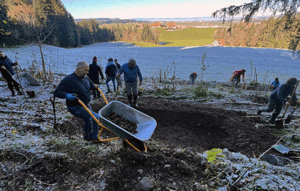
Der Frühling naht – Begleiten Sie uns zu einem außergewöhnlichen Naturerlebnis! Unser Entdeckungspfad zur Honigbi...
Besichtigung des Entdeckungspfads zur Honigbiene, einem Waldinsekt FreeTheBees hat es sich zur Aufgabe gemacht, d...
Important information
Important information: The texts are published in German and translated automatically into French, Italian and English. As far as possible, we check these translations. We apologize in advance if you discover a typo. You are very welcome to report it to bee@freethebees.ch
